Showing posts with label standards. Show all posts

Wednesday, August 14, 2024

The Costs of Buying a Home


If you have never purchased a home before, there are a lot of things you probably do not know about the process. Beyond finding that home on your favorite real estate app, what does it actually take to go from scrolling through pictures and daydreaming to getting the keys and moving in?

Sales Price

The one thing everyone sees is the sales price - this is probably something you have even used to put a filter on your search. In different markets, this number may be anywhere to close to what the home sells for, or significantly different. The important thing about this number is that it is determined by the seller. Sure, they may have had a listing agent run data from the neighborhood and give advice on that price, but the sales price is always set by the seller. In the last few years, the sales price listed on a property has often been referred to as the "starting offer" as homes can escalate above list price. As things have settled down a bit, that sales price is closer to reality. In the last month (July '24) the average sold price was 102% of the list price, and yet we are still having instances of intense competition - the highest percent over list price for July was 187%.

Financing

Ok, you've found the home of your dreams, how are you going to pay for it? Have you spoken to a lender? Found out what you can borrow? What are the current rates? What kind of programs do they have that may save you money or allow you to move forward?  What amount of money do you have saved up for the downpayment? Do you need a downpayment? There are programs for very low downpayments (and VA loans with $0 downpayment) but of course, as I'm sure you know, the less you borrow, the lower your mortgage payments will be. The lending process can be very convoluted, and talking to an experienced lender who can explain everything to you early on will make a huge difference in your home buying experience. 

Wait, that's not all - You Need More Money

You don't just need a downpayment to purchase a house, you also need to pay the professionals who provide valuable services to you along the way. The Lender, your Agent, the Home Inspector(s), the Title Company, the HOA if there is one, Insurance... oh, and the Government too. Property, Transfer and Recordation taxes owed to the government along with these other services will all depend on where you are purchasing and are based on the value of the home. These fees (minus any inspections - which are paid at the time of service) will add together to make up what is called "Closing Costs" i.e. the money that needs to be brought to the table on closing day when you take ownership of the home. The Lender and your agent can help you to estimate what these costs will be once you have a budget for your dream home. After closing you'll have movers and utilities to set up, and maybe you've decided to do some work to the home before you move in. All things to consider when saving that nest egg.

Your Guide Through It All

Your real estate agent acts as a sort of "GC" for the buying process. An experienced agent will have references for good vendors for lending, for home inspectors, for contractors, for moving, for title work - vendors they have worked with before and trust to do a good job. This knowledge alone is invaluable and can save you time, energy and stress. They can also be your "concierge service" - your first call when you have a question. Even though a real estate agent isn't a lawyer, lender or a home inspector, they will know where to get the answers you need, whatever your questions may be. A good agent is going to get you through the buying process smoothly and educate you with the knowledge you need to make confident decisions. Your agent's compensation is negotiated when you sign the required-by-law buyers agreement - a document that officially hires an agent to work for you as your personal representative and fiduciary.  This document lays out protections for buyers and also for agents, it has a beginning and extendable end date, and it specifies how your agent will be paid for their service.

How much does Agent Representation Cost?

It varies. I can tell you how much I personally charge for my services, but agents are people with varying skills and varying services. There are discount services who will not be all that I described above - they won't be there for your every call and question and you will be on your own to navigate much of the process that lies outside of showings and writing offers. In fact, you can even choose to be on your own to find homes that fit your needs and write an offer completely unrepresented "fill in the blank" style - no guidance, no explanations of what you are signing - if you so choose. The recent lawsuits against various Real Estate Associations were heavily focused on buyer agent fees and transparency. Here in Maryland, we have had buyer representation and buyer agreements that protect buyers and explain representation for decades, but in some areas of the country, they have only just been mandated to start using buyer agreements as a result of the lawsuits. 

Another result of the lawsuit is to make sure that everyone knows that compensation is negotiable. That doesn't mean agents can't dictate what they charge for their services, it just means it's negotiable.  An article came out in the last week that suggested that buyers should not pay more than 2% to their agent and the industry was left wondering where they got that number, what they were considering when coming up with what fair compensation might be for a real estate agent who has worked with a client for multiple years looking for that perfect home. Have they taken into consideration the years of knowledge and experience a buyer might have access to, the monetary benefits of access to vendors who have been vetted for their professionalism and quality of work? What about the value of having someone who will answer your text at 8pm on a Thursday or 2pm on a Sunday to set your mind at ease about some question that just popped into your head? What other business holds these kinds of working hours? I get a daily e-mail from the singular Leonard Steinberg of Compass and today's message had his own opinion on this very article which in return prompted me to write today's blog. Here is a blurb from his e-mail as food for thought. 

"

The Consumer Federation of America -  a non-profit organization founded in 1968 to advance consumer interests through research, education and advocacy - came out with a bold proclamation recently stating that when negotiating compensation with buyer agents, buyers should settle on a dollar amount that pays buyer agents no more than 2% of a home's sale price. Why 2%?

This very well-intentioned organization obviously wishes to bring down home buying costs for the consumer, and who can blame them as wages have not kept up with inflation in areas and the rising costs of everything over the past few decades has driven a big chunk of the US population into further wealth disparity. Could you live off a $20/hour wage before taxes in New York City and pay for health insurance, housing, education, transportation? While baying for 'no more than 2%' buyer commissions, why did they not address the costs agents incur to do business too? Why no limits on those costs? Advertising? Health insurance? Transportation? Technology? Insurance? Legal work? The list goes on. Have they ever promoted a "No more than $_____" for a cab ride? An airplane ticket? A lawsuit? Tips? Are the commissions retail staff get paid disclosed? Surely they have to understand that often the purchase process extends well beyond the obvious, often starting YEARS before a transaction occurs? This narrative perpetuates the myth that agents are paid merely for facilitating a transaction and that ALL that commission lands in their bank accounts without splits, taxes or any expenses. Did they factor all the work agents do that never culminates in a transaction ....or any payment?

Commissions are negotiated. They always have been negotiated. Buyers have always had the option to go it alone. Limiting what you pay someone exists almost nowhere else in the US economy - a free market system - so why real estate buyer brokerage commissions? Many of these organizations promote minimum wages for almost all workers: if they are promoting a maximum of 2%, why not a minimum too? What about all the work many agents do that result in ZERO pay? Shouldn't they promote an hourly pay in the event a buyer does not buy?

I am asking lots of the questions none in the media seem to be asking: one has to wonder why......? 🤔

 "

If you or someone you know is thinking about buying or selling property in Maryland or Northern VA, reach out anytime for a free consultation. 

Thursday, February 17, 2022

It's Not a Bubble, and Here's Why


4 Simple Graphs Showing Why This Is Not a Housing Bubble

4 Simple Graphs Showing Why This Is Not a Housing Bubble | MyKCM

recent survey revealed that many consumers believe there’s a housing bubble beginning to form. That feeling is understandable, as year-over-year home price appreciation is still in the double digits. However, this market is very different than it was during the housing crash 15 years ago. Here are four key reasons why today is nothing like the last time.

1. Houses Are Not Unaffordable Like They Were During the Housing Boom

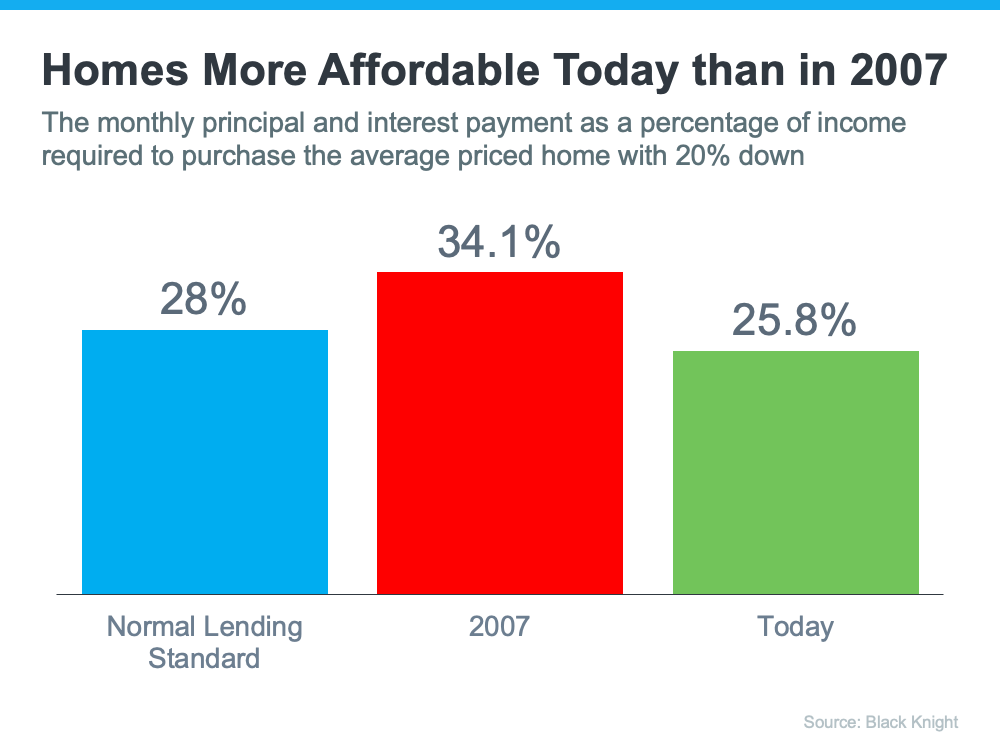
The affordability formula has three components: the price of the home, wages earned by the purchaser, and the mortgage rate available at the time. Conventional lending standards say a purchaser should not spend more than 28% of their gross income on their mortgage payment.

Fifteen years ago, prices were high, wages were low, and mortgage rates were over 6%. Today, prices are still high. Wages, however, have increased, and the mortgage rate, even after the recent spike, is still well below 6%. That means the average purchaser today pays less of their monthly income toward their mortgage payment than they did back then.

In the latest Affordability Report by ATTOM Data, Chief Product Officer Todd Teta addresses that exact point:

“The average wage earner can still afford the typical home across the U.S., but the financial comfort zone continues shrinking as home prices keep soaring and mortgage rates tick upward.”

Affordability isn’t as strong as it was last year, but it’s much better than it was during the boom. Here’s a chart showing that difference:

4 Simple Graphs Showing Why This Is Not a Housing Bubble | MyKCM

If costs were so prohibitive, how did so many homes sell during the housing boom?

2. Mortgage Standards Were Much More Relaxed During the Boom

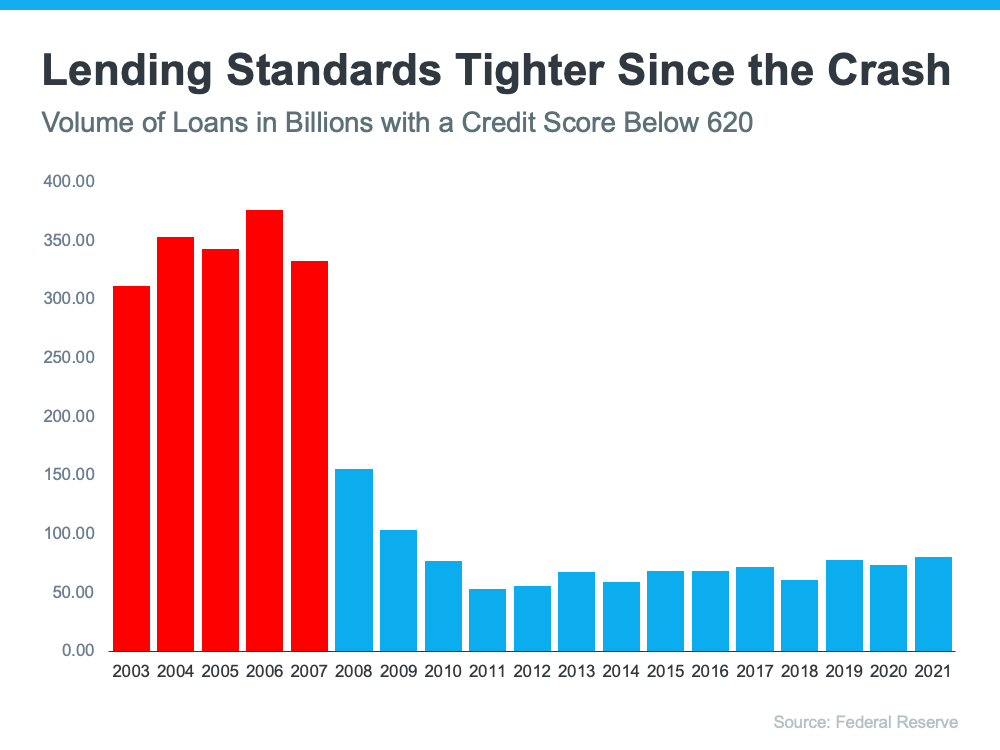
During the housing bubble, it was much easier to get a mortgage than it is today. As an example, let’s review the number of mortgages granted to purchasers with credit scores under 620. According to credit.org, a credit score between 550-619 is considered poor. In defining those with a score below 620, they explain:

“Credit agencies consider consumers with credit delinquencies, account rejections, and little credit history as subprime borrowers due to their high credit risk.”

Buyers can still qualify for a mortgage with a credit score that low, but they’re considered riskier borrowers. Here’s a graph showing the mortgage volume issued to purchasers with a credit score less than 620 during the housing boom, and the subsequent volume in the 14 years since.

4 Simple Graphs Showing Why This Is Not a Housing Bubble | MyKCM

Mortgage standards are nothing like they were the last time. Purchasers that acquired a mortgage over the last decade are much more qualified. Let’s take a look at what that means going forward.

3. The Foreclosure Situation Is Nothing Like It Was During the Crash

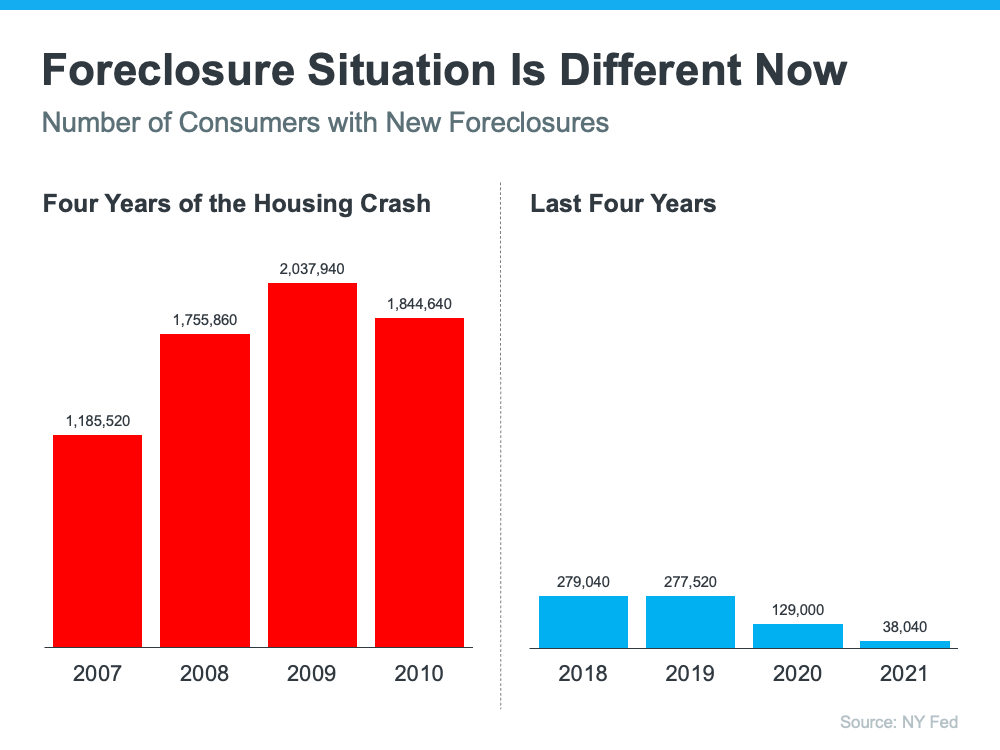
The most obvious difference is the number of homeowners that were facing foreclosure after the housing bubble burst. The Federal Reserve issues a report showing the number of consumers with a new foreclosure notice. Here are the numbers during the crash compared to today:

4 Simple Graphs Showing Why This Is Not a Housing Bubble | MyKCM

There’s no doubt the 2020 and 2021 numbers are impacted by the forbearance program, which was created to help homeowners facing uncertainty during the pandemic. However, there are fewer than 800,000 homeowners left in the program today, and most of those will be able to work out a repayment plan with their banks.

Rick Sharga, Executive Vice President of RealtyTracexplains:

“The fact that foreclosure starts declined despite hundreds of thousands of borrowers exiting the CARES Act mortgage forbearance program over the last few months is very encouraging. It suggests that the ‘forbearance equals foreclosure’ narrative was incorrect.”

Why are there so few foreclosures now? Today, homeowners are equity rich, not tapped out.

In the run-up to the housing bubble, some homeowners were using their homes as personal ATM machines. Many immediately withdrew their equity once it built up. When home values began to fall, some homeowners found themselves in a negative equity situation where the amount they owed on their mortgage was greater than the value of their home. Some of those households decided to walk away from their homes, and that led to a rash of distressed property listings (foreclosures and short sales), which sold at huge discounts, thus lowering the value of other homes in the area.

Homeowners, however, have learned their lessons. Prices have risen nicely over the last few years, leading to over 40% of homes in the country having more than 50% equity. But owners have not been tapping into it like the last time, as evidenced by the fact that national tappable equity has increased to a record $9.9 trillion. With the average home equity now standing at $300,000, what happened last time won’t happen today.

As the latest Homeowner Equity Insights report from CoreLogic explains:

“Not only have equity gains helped homeowners more seamlessly transition out of forbearance and avoid a distressed sale, but they’ve also enabled many to continue building their wealth.”

There will be nowhere near the same number of foreclosures as we saw during the crash. So, what does that mean for the housing market?

4. We Don’t Have a Surplus of Homes on the Market – We Have a Shortage

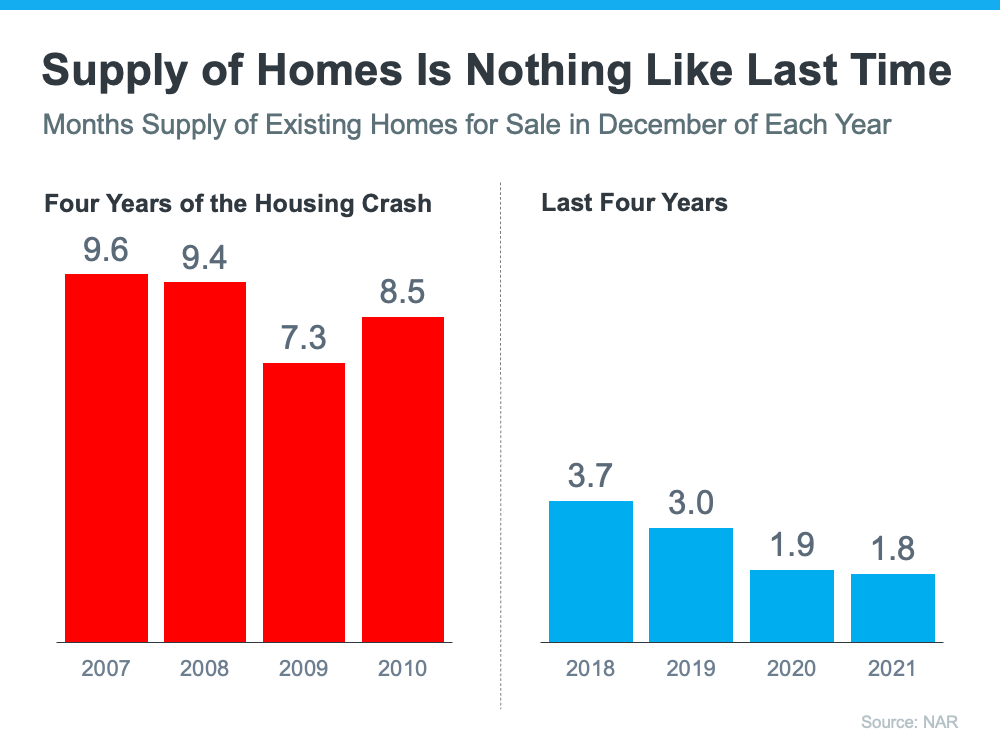
The supply of inventory needed to sustain a normal real estate market is approximately six months. Anything more than that is an overabundance and will causes prices to depreciate. Anything less than that is a shortage and will lead to continued price appreciation. As the next graph shows, there were too many homes for sale from 2007 to 2010 (many of which were short sales and foreclosures), and that caused prices to tumble. Today, there’s a shortage of inventory, which is causing the acceleration in home values to continue.

4 Simple Graphs Showing Why This Is Not a Housing Bubble | MyKCM

Inventory is nothing like the last time. Prices are rising because there’s a healthy demand for homeownership at the same time there’s a shortage of homes for sale.

Bottom Line

If you’re worried that we’re making the same mistakes that led to the housing crash, the graphs above show data and insights to help alleviate your concerns.

Why I Still Think You Should Buy That House, Even Now.

  Invest in Yourself by Owning a Home Are you wondering if it makes sense to buy a home right now? While today’s mortgage rates might seem a...